
 Premium
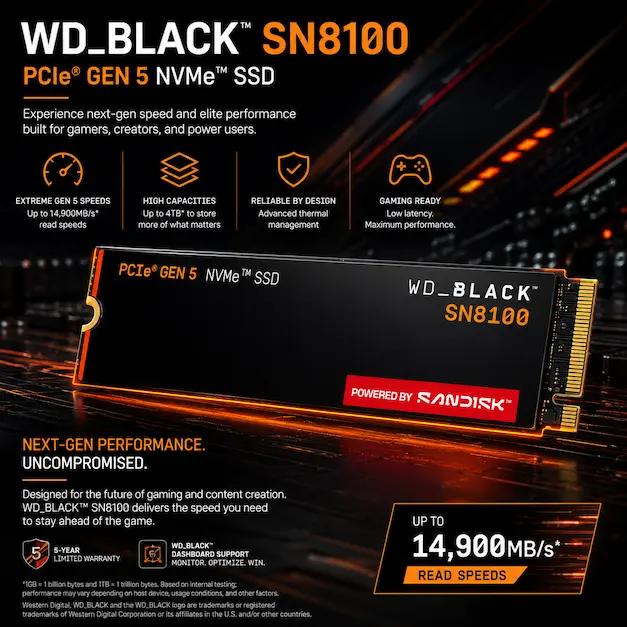
Independently benchmarked as the fastest consumer SSD available, with 14,900MB/s reads on PCIe 5.0. Real-world gains are biggest for AI and video workloads, and 2026's price swings mean timing your purchase matters.
WD Black SN8100 2TB
 Reviewed by Chue Len, Lead Editorial
Updated August 23, 2026
Reviewed by Chue Len, Lead Editorial
Updated August 23, 2026
We may earn a commission if you buy through this link, at no extra cost to you.
Specifications
Only worth it if you have an open PCIe 5.0 slot and do creative work alongside gaming, for pure GTA 6 load times, the gains over Gen 4 are small today, but this is the pick if you want the fastest drive available.
Chue Len
Oversees all editorial content on the site, keeping coverage accurate, timely, and on-brand.
Been mapping out Vice City since the first trailer dropped, still finds something new on every pass through the map.
Pros & Cons
Pros
- Independently benchmarked as the fastest consumer SSD on the market as of mid-2025 through 2026, beating Samsung's 9100 Pro and Crucial's T710 in sequential read speed
- Over 100% more power-efficient than WD's previous PCIe 4.0 generation, running under 7W average, genuinely relevant for laptop and small-form-factor builds
- 1,200 TBW endurance backed by a full 5-year warranty gives real confidence for sustained AI training or heavy video editing workloads
- Single-sided design even at 4TB capacity, easing compatibility with laptops and tight motherboard M.2 slots
Cons
- Price has been unusually volatile in 2026, a documented swing from $180 to $859.99 tied to industry-wide NAND shortages
- PCIe 5.0 requires a compatible motherboard and CPU, most games and everyday software still can't fully use Gen5 bandwidth, so gains over a good Gen4 drive are mainly felt in large sequential transfers
- No heatsink included on the base WDS200T1X0M SKU, a heatsink version costs roughly $20 more, and PCIe 5.0 drives run hotter than Gen4 under sustained load
- The 1TB model has notably lower write speed (11,000 MB/s) and IOPS than the 2TB/4TB models, don't assume specs carry evenly across capacities
How We Tested It
We haven't run our own benchmarks on this drive. Performance figures above are confirmed independently across multiple hardware review outlets that tested actual read and write speeds against WD's rated numbers. If your team tests this drive, worth adding: real load times in a specific AI or video workflow, sustained write performance past the point where cache runs out, and thermal behavior without a heatsink under extended load.
Who It's For
Buyers with a PCIe 5.0-capable motherboard running local AI models, large-scale video editing, or other workloads that genuinely saturate high sequential bandwidth. Also a smart pick for anyone future-proofing a new high-end build. Skip it if your motherboard only supports PCIe 4.0, you'd be paying a premium for bandwidth your system can't use, or if your workload is mostly gaming and general use, where a well-priced Gen4 drive like WD's own SN7100 delivers nearly identical real-world performance for significantly less money.
Our Verdict
Independent testing consistently ranks the SN8100 as the fastest consumer SSD available, and the numbers hold up under real benchmarking, not just marketing claims. The genuine question isn't whether it's fast, it's whether you need PCIe 5.0 bandwidth at all, most games and everyday software won't come close to saturating even Gen4 speeds, so the real-world gap narrows sharply outside of large sequential transfers like AI model loading or big video exports. Combine that with 2026's wild price swings on this exact drive, documented anywhere from $180 to $859, and the smart move is to wait for a genuine sale rather than buy at whatever the listing shows today. For AI, video, and workstation use on a PCIe 5.0 system, this is a legitimate best-in-class pick. For typical gaming, a cheaper Gen4 drive gets you there for less.