
 Premium
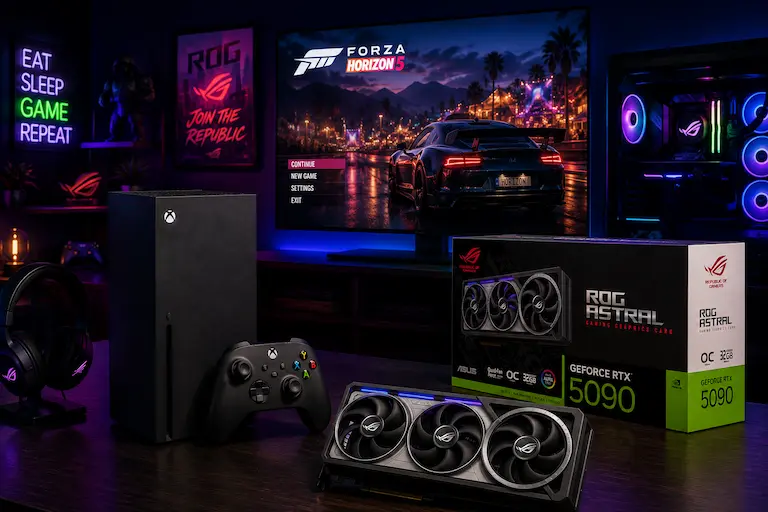
Quad-fan cooling and higher factory clocks set this apart from NVIDIA's reference RTX 5090. Price has swung by over $1,000 within the same year, so timing matters more than usual. Confirm you're buying the OC Edition, not one of ASUS's several other Astral variants.
ASUS ROG Astral NVIDIA GeForce RTX 5090
 Reviewed by Chue Len, Lead Editorial
Updated August 23, 2026
Reviewed by Chue Len, Lead Editorial
Updated August 23, 2026
We may earn a commission if you buy through this link, at no extra cost to you.
Specifications
Chue Len
Oversees all editorial content on the site, keeping coverage accurate, timely, and on-brand.
Been mapping out Vice City since the first trailer dropped, still finds something new on every pass through the map.
Pros & Cons
Pros
- Quad-fan design and a vapor chamber built specifically for this card, not a shared cooler across multiple GPU tiers
- Higher factory clocks than NVIDIA's reference 5090, 2,610 MHz boost versus stock
- 32GB of GDDR7 handles both native 4K/8K gaming and local AI workloads without compromise
- 3-year warranty from ASUS, longer than what several competitors offer at this tier
Cons
- 3.8-slot size needs real case clearance. Confirm your case supports it before you buy.
- ASUS sells the RTX 5090 under at least six different Astral names, OC, White, White OC, BTF, LC, and the $5,499 Edition 20. Confirm which one you're getting.
- Price swings of $1,000 or more within the same year aren't unusual for this specific card right now
- This card alone can cost more than an entire mid-range gaming PC
How We Tested It
We haven't run our own thermal or gaming benchmarks on this card. Specs above come from ASUS's own documentation and retailer listings. If your team runs this card, worth adding: sustained boost clocks under a 30-minute load, actual noise levels at full fan speed, and real 4K frame rates in a couple of current titles. That's the section that would differentiate this page from a spec sheet reprint.
Who It's For
Buyers who've already decided on an RTX 5090 and want ASUS's best cooling and build quality over a reference-style card, native 4K or 8K gamers, and anyone running local AI workloads where 32GB of VRAM is the actual bottleneck. Skip it if you're gaming at 1440p or below, where this card's advantages barely register, or if you're price-sensitive at all. A 5070 Ti or 5080 gets you most of the real-world gaming performance for a fraction of the cost.
Our Verdict
Among 5090 partner cards, this is one of the better-built options, real engineering behind the cooling, not just a bigger heatsink slapped on a reference board. The problem isn't the card. It's the market around it. Prices for this exact SKU have ranged from under $2,800 to nearly $4,900 within months, driven by the same memory shortage hitting GPUs across the board. Buy it when it's closer to the low end of that range, and confirm you're looking at the OC Edition specifically, not one of ASUS's five other Astral variants sharing a similar name.