
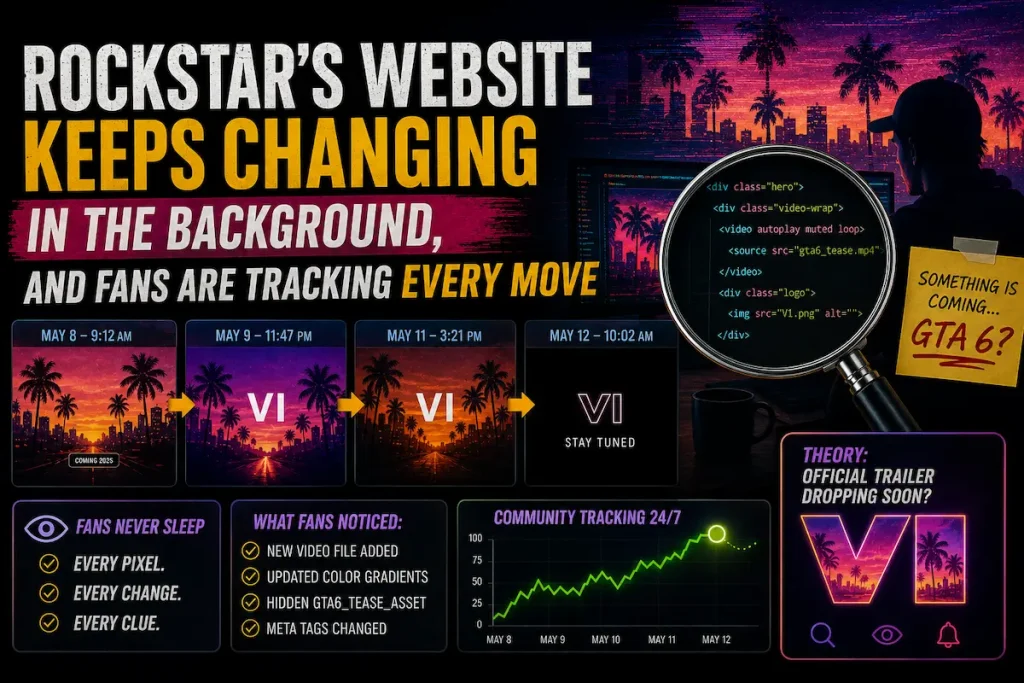
While most of the official GTA 6 news has come through big, scheduled announcements like trailers, earnings calls, and the Netflix reveal, there’s a quieter, more obsessive strand of coverage happening in parallel: a group of community developers who have essentially turned Rockstar’s own website into a live investigation.
What the Trackers Are Finding
Using tracking tools built to monitor changes on the official GTA 6 site, these fans have picked up on multiple backend updates over the past several weeks, the kind of changes that don’t show up as anything visible to a normal visitor, but that get flagged the moment new code, new metadata, or new page structures get pushed live. On their own, backend updates like this happen constantly on any actively maintained website and usually mean nothing more than routine technical housekeeping. But Rockstar’s site has been treated as unusually sacred ground by this community for years, precisely because the studio has a track record of quietly prepping infrastructure, new pages, hidden assets, updated metadata, shortly before major announcements. When that pattern shows up again, longtime trackers don’t dismiss it as noise.
An Insider’s Vague but Notable Comment
This detective work has been happening alongside separate comments from a well-known industry insider who goes by NateTheHate. Asked directly about the possibility of a gameplay reveal, he said this month that he expects a “fair bit” of new GTA 6 information to surface soon, a deliberately vague statement, but one that carries weight given his track record of being plugged into industry chatter before things go officially public. Combine that comment with the website’s backend movement and you get the kind of loosely connected but suggestive pattern that’s become the norm for how GTA 6 news gets pieced together these days: no single source confirms anything outright, but several independent threads start pointing in the same direction around the same time.
How Much of This Is Confirmed
It’s worth being clear-eyed about how speculative all of this is. None of it is confirmation from Rockstar. Website changes are not announcements. An insider saying he “expects” news is not the same as news existing yet. The most honest framing floating around fan communities is that August 2026 should be treated as a likely window for further updates, not a locked date for anything specific. The website movement and insider comments point toward something being prepared behind the scenes, but they don’t specify what, when exactly, or in what form.
That said, context matters here too. This particular wave of speculation started gaining traction before Rockstar officially confirmed the Netflix Extended Look for August 27, meaning that, in this specific case, the pattern-watchers turned out to be right that something significant was coming, even if they couldn’t have named the exact Netflix partnership angle in advance. That kind of track record is exactly why this community keeps doing what it does: it’s not perfect, and it’s often more wrong than right in the specifics, but the general instinct, that clusters of small technical and insider signals tend to precede real announcements, has been validated often enough that fans aren’t willing to stop watching.
What Might Come Next
Going forward, the most likely categories of any further reveal remain fairly predictable even without inside knowledge: a new trailer or extended gameplay segment, a marketing image refresh timed around the Extended Look, updated pre-order or platform messaging, or clarified details around collector content that hasn’t been confirmed yet. Anything beyond that, specific collector’s edition contents, surprise platform announcements, online multiplayer details, remains firmly in speculation territory until Rockstar puts it on the record itself. Until then, the backend-watchers will keep watching, because for a studio this quiet, a single new line of website code is sometimes the closest thing fans get to an actual clue.
Why This Kind of Fan Investigation Exists at All
It helps to understand why this specific style of fan investigation exists at all, and it comes down to Rockstar’s unusually tight-lipped communication style compared to most major publishers. Where a lot of studios run active social accounts posting regular updates, behind-the-scenes content, and community engagement, Rockstar has built its entire public image around silence punctuated by rare, deliberate reveals. That approach creates real information scarcity, and community trackers have essentially built an entire secondary information ecosystem to fill the gap, parsing file structures, image metadata, and page source code for anything that might hint at what’s coming before Rockstar says so officially. It’s a strange kind of amateur journalism that’s grown up specifically around this one company’s habits, and it wouldn’t really work the same way against a publisher that already tells its fans everything upfront.
There’s an important caveat that gets lost sometimes in the excitement of a new detected change: not every backend update is meaningful, and trackers themselves are usually the first to admit that most of what they find turns out to be routine maintenance with nothing behind it. Server migrations, content management system updates, and basic security patches all produce the same kind of detectable backend movement as an actual pre-announcement content push, and there’s no reliable way to tell the two apart from the outside. The community has gotten reasonably good at pattern-matching over the years by comparing new detections against Rockstar’s historical behavior before past announcements, but it remains an inexact science built on educated guessing rather than anything close to certainty.
There’s also a slightly awkward tension baked into this whole practice that’s worth acknowledging honestly. On one hand, this kind of grassroots tracking has genuinely predicted real announcements before they happened, which is exactly why the community keeps doing it and why other fans keep paying attention to what they find. On the other hand, treating every website hiccup as a coded message can also feed a kind of low-level anxiety and constant refreshing that isn’t especially healthy for anyone deeply invested in this game’s release. It’s worth holding both of those things at once: the detective work is a genuinely interesting and occasionally accurate hobby, but it’s also perfectly fine to just wait for Rockstar’s official channels instead of parsing backend code for clues that may or may not mean anything at all.
Website tracking observations described here come from independent fan communities and have not been confirmed by Rockstar.